

Choosing a beard based on face shape is the fastest way to go from looking average to looking intentionally sharp. Most men pick a beard style because they saw it on someone else or because it is trending. That rarely works. The beard that looks great on a square jawline can make a round face look wider. The style that slims a long face will make an oval face look unbalanced.
The good news is that once you know your face shape, the right beard choice becomes straightforward. This guide walks you through every face shape, the specific beard styles barbers actually recommend for each one, and how to maintain your look at home.
Table of Contents

Why Matching Your Beard to Your Face Shape Matters
Featured Snippet Answer: A beard matched to your face shape creates visual balance by adding length where the face is short, width where it is narrow, and softening angles that are too sharp. It is the same principle barbers and portrait photographers have used for decades to make faces look proportionally ideal.
Your face is a three dimensional structure made up of bone, muscle, and soft tissue. Facial hair sits on top of that structure and either enhances it or fights against it. According to grooming experts at Gillette, the universal goal of any beard style is to help your face approximate the proportions of an oval shape, since oval is considered the most balanced facial structure.
When you understand this principle, choosing a beard stops being guesswork and starts being a system.
How to Find Your Face Shape at Home
Featured Snippet Answer: Take four measurements with a tape measure: forehead width, cheekbone width, jawline width, and face length from hairline to chin. The relationship between those four numbers tells you your face shape.
Here is exactly how to measure:
Step 1: Measure your forehead width Place the tape measure across your forehead at its widest point, roughly halfway between your eyebrows and your hairline.
Step 2: Measure your cheekbone width Start at the outer corner of one eye and measure across the bridge of your nose to the outer corner of the other eye.
Step 3: Measure your jawline Begin at the sharpest angle of your jaw, just below each ear, and measure to the centre of your chin. Double that number for the full jaw measurement.
Step 4: Measure your face length Run the tape from the centre of your hairline straight down to the tip of your chin.
Write all four numbers down. You will use them to match yourself to one of the seven face shapes below.
The 7 Face Shapes and What Makes Each One Unique
Featured Snippet Answer: The seven male face shapes are oval, round, square, rectangular, heart, diamond, and triangle. Each shape has a distinct ratio of forehead, cheekbones, and jawline width to face length.
| Face Shape | Widest Point | Key Feature | Face Length vs Width |
| Oval | Cheekbones | Balanced proportions | Length is 1.5x the width |
| Round | Cheeks | Soft angles, no jaw definition | Nearly equal width and length |
| Square | Jaw | Wide, flat jawline matches forehead | Roughly equal on all measurements |
| Rectangular | Forehead | Long and narrow with a squared jaw | Length significantly greater than width |
| Heart | Forehead | Wide top, narrow pointed chin | Forehead noticeably wider than jaw |
| Diamond | Cheekbones | Very prominent cheekbones | Narrow forehead and chin |
| Triangle | Jaw | Heavy lower face, narrower forehead | Wide jaw dominates |
According to grooming research published by Braun, most men fall into one primary shape, though some sit on the border between two. When in doubt, go with the shape whose measurements are closest to your own.
Now that you know your shape, the next section covers exactly which beard styles work for each one and which ones to avoid entirely.
Best Beard Styles by Face Shape: Expert Recommendations
Featured Snippet Answer: The best beard for your face shape adds volume where you need it most. Round faces need chin length, square faces need softened angles, and rectangular faces need side width. Oval faces can wear almost any style with confidence.
Oval Face Shape
An oval face is the most forgiving shape for beard styling. According to grooming experts at Cremo, oval faces can pull off virtually any beard style from heavy stubble to a full Bandholz beard because the proportions are already naturally balanced.
The one thing to avoid is adding excessive chin length, which can push the face into rectangular territory.
Top picks for oval faces:
- Short boxed beard at 5 to 10mm for a clean professional look
- Full beard trimmed at the cheeks for a bold masculine appearance
- Beardstache for a modern, high contrast style
Round Face Shape
The goal on a round face is always vertical. You want to create the illusion of length and reduce the appearance of width at the cheeks.
Top picks for round faces:
- Van Dyke beard with a pointed chin and disconnected moustache
- Extended goatee that builds downward length at the chin
- Anchor beard that draws the eye toward a defined chin point
Avoid wide full beards with heavy cheek growth. According to barbers at Salt City Barbershop, pairing a beard fade with a mid to high skin fade hairstyle gives round faces the sharpest possible definition.
Square Face Shape
Square faces have angular, well defined jawlines that already command attention. The beard should soften those edges rather than compete with them.
Top picks for square faces:
- Circle beard that introduces rounded lines against a sharp jaw
- Classic goatee that draws the eye downward to the chin
- Low fade beard that tapers the sides without hiding the jawline
Grooming specialists at Braun UK note that the golden rule for square faces is keeping the beard short overall so the jawline remains the focal point rather than disappearing under bulk.
Rectangular and Heart Face Shapes
Rectangular faces need side volume, not chin length. A full beard with shorter chin hair and thick sideburns works best. Avoid goatees and pointed styles that stretch the face further downward.
Heart shaped faces need the opposite approach. Focus all volume at the chin and keep the cheeks minimal. A rounded goatee or extended goatee balances the wide forehead by visually grounding the lower half of the face.
What to Do If You Have a Patchy Beard
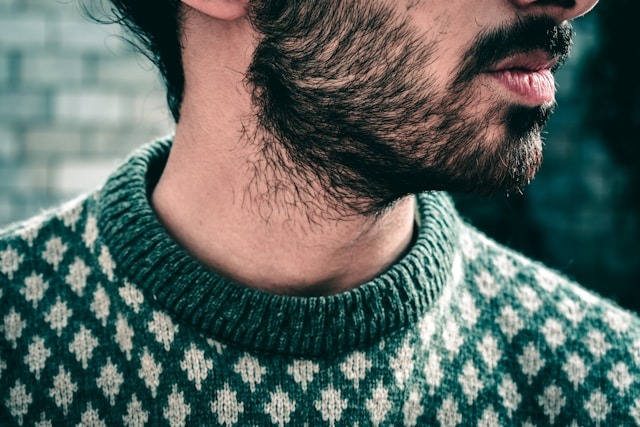
Featured Snippet Answer: Men with patchy beards should choose styles that work with their natural growth rather than against it. Goatees, Van Dyke beards, and designer stubble are the most effective options for uneven facial hair.
Research from Philips grooming confirms that styles focusing hair on the chin area such as goatees, thick chin straps, and Van Dyke beards are the strongest choices for men with sparse cheek growth.
If patches are widespread, let the beard grow freely for six to eight weeks before trimming anything. Longer surrounding hair naturally covers thinner areas as it fills in.
Supporting your beard from the inside matters too. Foods rich in biotin such as eggs and nuts, along with zinc found in seeds and lean meats, support healthier follicle activity according to nutritional guidance from Philips.
Simple Beard Maintenance Routine for Every Face Shape
Featured Snippet Answer: Maintain your beard with daily oiling, brushing, and neckline checks. Wash two to three times per week with a dedicated beard shampoo and trim weekly to keep your face shape specific style intact.
According to grooming experts cited by Boca Raton Observer, washing the beard two to four times weekly with a beard specific cleanser prevents dryness and skin irritation without stripping natural oils.
Follow this simple weekly schedule:
- Daily Apply beard oil after showering and brush in the natural growth direction
- Every 2 to 3 days Wash with beard shampoo and follow with beard balm
- Weekly Trim to your designated guard length and sharpen your cheek and neckline
- Monthly Visit a barber for a full professional reshape
Conclusion
Getting your beard based on face shape right is not complicated once you understand the core principle: your beard should balance what nature gave you. Round faces need length at the chin. Square faces need softened angles. Rectangular faces need side volume. And oval faces have the freedom to experiment.
Start by measuring your face today. Pick one style from the recommendations above that fits your shape and commit to it for at least six weeks. Grooming is a long game, and consistency always wins over impulse trimming.
If this guide helped you find your style, share it with a friend who is still figuring out his beard. Drop a comment below telling us your face shape and which style you are trying. We read every single one.
What is the best beard for a round face?
The Van Dyke beard and extended goatee are the strongest choices for round faces because both styles build vertical length at the chin and keep the cheeks free of bulk. Keeping the sides trimmed at a short guard length while growing chin hair longer creates the most effective slimming effect.
Can a beard make your face look slimmer?
Yes, a well chosen beard absolutely makes the face appear slimmer. Styles with longer chin hair and shorter or faded sides create a vertical visual line that elongates the face and reduces the perception of width. This is especially effective for round and full faced men.
How do I know my face shape for a beard?
Measure your forehead width, cheekbone width, jawline width, and face length using a tape measure while standing in front of a mirror. Comparing these four measurements reveals whether your face is oval, round, square, rectangular, heart, diamond, or triangle shaped.
What beard style works for patchy growth?
The goatee, Van Dyke, and Balbo beard are the top three styles for patchy growers because all three intentionally leave the cheeks bare. This turns sparse cheek growth from a flaw into part of the deliberate design.
How long does it take to grow a beard worth styling?
Most men need four to six weeks of uninterrupted growth before they have enough length to assess their natural growth pattern and make informed style decisions. Trimming too early removes the data your barber needs to recommend the right shape for your face.